




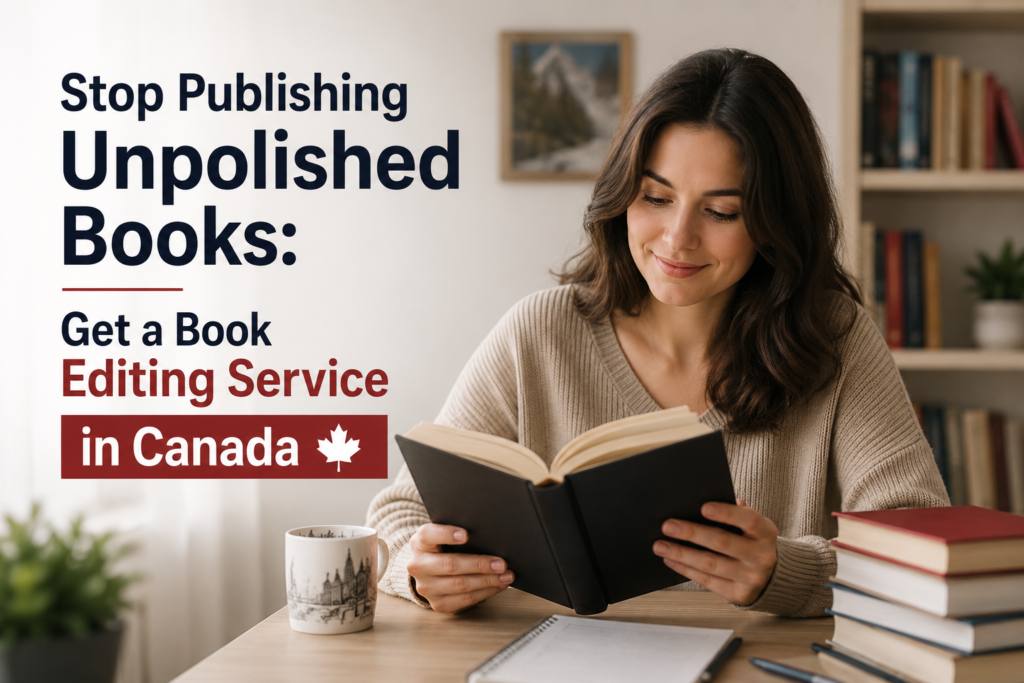





















































































































Stop Publishing Unpolished Books: Get a Book Editing Service in Canada


Is Your Manuscript Really Ready for Readers?
Finishing a manuscript is a major milestone, but it is not the final step before publishing. Many authors become so focused on completing their books that they overlook the importance of careful editing. A first draft, no matter how much effort has gone into it, almost always contains areas that need improvement.
Readers notice more than spelling mistakes. They pay attention to how smoothly the story flows, whether ideas connect naturally, and if the writing keeps them engaged from beginning to end. Even a strong concept can lose its impact when the manuscript has inconsistent pacing, repetitive sections, or unclear language.
Professional editing helps transform a completed draft into a polished book that readers can enjoy with confidence. Instead of changing the author’s unique voice, editing strengthens it by removing distractions that interrupt the reading experience.
Why Publishing Too Early Can Hurt Your Book
Most authors get very excited about their completed manuscripts and wish to publish as soon as they can. While this excitement is understandable, it may cause a lot of trouble for the author which can be hard to solve after publishing.
The most common mistakes made when writing include:
- Grammar and punctuation mistakes.
- Repetitive words and awkward sentence construction.
- Mismatched characters’ information and facts.
- Hastily written or excessive chapters.
- Poor transitions between different concepts.
- Incorrect formatting, making reading harder.
As soon as people start to give negative reviews of the book, its reputation will be much harder to improve. It is always easier to edit a book before publishing rather than trying to restore the author’s reputation.
What Does Professional Book Editing Actually Improve?
However, editing does not simply involve spelling corrections. It is an extensive analysis of the whole book to improve clarity and consistency.
The type of editing will depend on what stage of the manuscript it is at. This could include:
- Sentence restructuring for better flow.
- Reducing redundancies.
- Grammar and punctuation corrections.
- Consistency in names, dates, and chronology.
- Better paragraph construction.
- Dialogue revisions to make the language sound more natural.
- Readability improvement while maintaining the original meaning of the work.
This results in an improved reading experience while allowing the author’s personality to come through.
Common Signs Your Manuscript Needs Another Round of Editing
Sometimes writers become so accustomed to their own writing that they fail to notice small errors.
If your manuscript shows any of the following symptoms, it needs some more editing:
- Very complicated sentences.
- The characters change their personalities all of a sudden.
- The repetition of the same point over and over again.
- Pacing problems within the chapters.
- Unnatural-sounding dialogue.
- Consistently getting comments from beta readers that certain passages are confusing.
Seeing these red flags before releasing your book will give you a chance to perfect your manuscript rather than disappoint future readers.
Self-Editing Has Limits
Self-editing is an important stage of the writing process, but it should not be regarded as the sole revision step. Each writer tends to develop peculiarities that prevent them from detecting particular errors. A short pause before editing the manuscript allows writers to find some evident errors, however, even professional writers might ignore some inconsistencies as a result of repeated reading of the same piece of work.
The objective attitude allows detecting errors which could not be noticed by the author himself/herself. Fresh eyes will see unclear phrases, weaknesses in the structure, and other points at which the readers can be puzzled or bored.
Choosing the Right Editing Support for Your Goals
Not all manuscripts need to be edited in the same way. Some will need just a final proofread while others will require more advanced editing before being published. It is important to know the differences to make the right investment in the appropriate editing service.
| Editing Yourself | Professional Editing |
| Familiar with the content | Brings a new, objective point of view |
| Can miss repeated errors | Finds underlying problems and inconsistencies |
| Little advice on structure | Enhances readability and organization |
| More revisions needed | Less time spent revising |
| Works best for early revisions | Effective for pre-publication edits |
The selection of the right type of edit should be determined by the state of the manuscript and not by the writer’s level of experience.
Having a well-edited manuscript provides a good foundation for everything else after. No matter what the writer’s intended use of the manuscript, from being published online to being printed, good editing helps to improve the reading experience and minimize possible bad reviews due to unnecessary errors.
If you are an author looking for tips from Top book writers in canada, there seems to be a common theme – a good book will hardly be available for reading without proper editing and revisions. A well-written book is generally created through the process of refining the manuscript.
Editing also helps to prepare the manuscript for the further stages of the publishing process. The clean and structured text will be much easier to format, proofread, and publish through various channels of publishing.
After the editing process is completed, it becomes possible for writers to focus their energy on reaching their audience. It should be noted that marketing techniques like Ebook Marketing & Book Promotion Services will be much more efficient in this case since they will be marketing a fine piece of work.
Conclusion
The publication process goes beyond writing the last page of the book. A manuscript requires a thorough check before it can be made available to the readers and editing makes a major contribution to this. By fixing the mistakes in the document and enhancing the whole reading experience, editing helps to turn the manuscript into a good book.
Editing one’s work before publishing it is an investment in the quality of the book and the reputation of the writer too. It ensures that the reader is left with a positive impression of the book and gets satisfied with the reading experience.